

Uzbek Cuisine: From Plov to Shirchoy
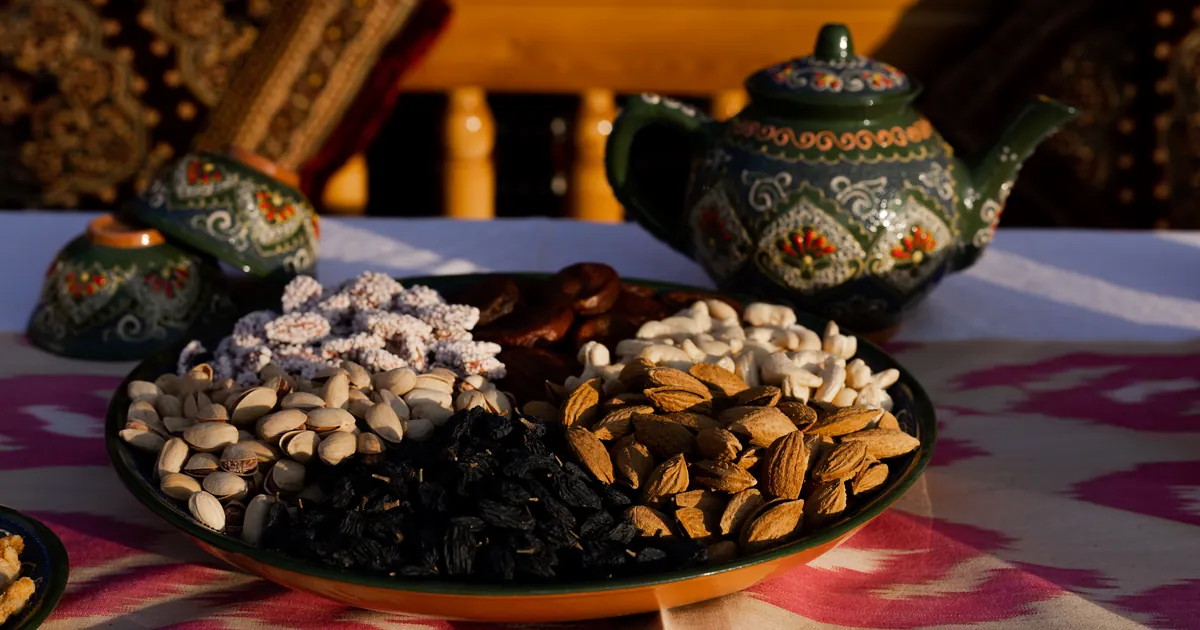
Uzbek cuisine grew up in the oases of Central Asia, including Fergana, Tashkent and Samarkand, and regional differences are still easy to taste. Its backbone is rice, mutton, carrots and onions, tandoor-baked bread and green tea. Many dishes are cooked in a kazan, and vegetables and grains are usually part of the dish itself rather than a separate side.
Plov
Plov (osh) is often called the national dish. Rice, meat, carrots and onions cook in a kazan over an open fire: first comes a zirvak of fried onion and carrot, then soaked rice is laid on top and finishes by steaming. Fergana plov tends to be darker and more fried, while Tashkent plov is lighter. For celebrations, chickpeas, raisins and barberries are added. At weddings, the morning plov (nahor oshi) is served early, roughly between six and nine.
Soups
• Shurpa: a soup of meat and fresh vegetables; across the region the word simply means soup.
• Mastava: a rice soup.
• Lagman and naryn: noodle dishes eaten as a soup or as a main course.
• Chalop: a chilled soup of yogurt, dill and cilantro.
Dough dishes
• Manti: steamed in a special steamer.
• Chuchvara: small Uzbek dumplings.
• Samsa: filled pastries baked in a tandoor or an oven.
Onions go into fillings generously: two or three parts onion to one part meat is not unusual.
Meat and the kazan
Mutton is the favorite, followed by beef. Tail fat and cottonseed oil give the dishes their characteristic flavor. Shashlik is grilled over coals, while dimlama is meat and vegetables stewed slowly under a lid.
Bread, tea and sweets
Bread (non) has a special place at the table: obi non is made from yeasted dough, patir is flaky and rich, and Tashkent is known for the plate-shaped lochira. Bread is placed face up and torn into pieces. Green tea is drunk all day from small bowls, usually unsweetened, and is offered with every meal. Shirchoy is a salty milk tea with butter, made for festive occasions. A celebratory meal ends with fruit, nuts and halvah.
Features and tips
1. Soak the rice for plov in advance and lay it on top of the zirvak: it should finish by steaming, not frying.
2. The classic proportion for plov is about equal parts meat and rice, with plenty of onion and carrot.
3. Typical spices are cumin, coriander, barberry and sesame; classic dishes are usually not very hot.
4. Plov is often served with achichuk, a salad of tomato, cucumber, onion and hot pepper.
5. At the table the eldest tastes first, and bread is torn by hand rather than cut.
Recipes on Oshxonam
• Tashkent plov
• Samarkand plov
• Fergana plov
• Lagman
• Lamb shurpa
• Mastava
• Lamb manti
• Meat samsa
• Chuchvara
• Naryn
• Lamb shashlik
• Uzbek flatbread (obi non)
• Shirchoy
• Dimlama
Sources:
Wikipedia — «Узбекская кухня»: https://ru.wikipedia.org/wiki/Узбекская_кухня
Wikipedia — «Uzbek cuisine»: https://en.wikipedia.org/wiki/Uzbek_cuisine
Wikipedia — «Gastronomía de Uzbekistán»: https://es.wikipedia.org/wiki/Gastronomía_de_Uzbekistán